
PRGR HS-130A vs Shot Scope LM1: Simple Practice Compared
The PRGR HS-130A and the Shot Scope LM1 are both small Doppler radar units that cost about $200 and show the same five core numbers. They are close enough that the deciding factor is usually not the data. It is what happens to your numbers after the session ends.
Research disclosure: We built this comparison from manufacturer and authorized retailer documentation checked October 9, 2026. Launch Monitor Pro has not tested either unit, so there are no accuracy scores here. Prices are listed prices at the time of writing.
The short answer
The Shot Scope LM1 is the better fit if you want your sessions saved to a phone app automatically and like a bigger color screen. The PRGR HS-130A makes more sense if you are doing speed training, especially with SuperSpeed training clubs, and are happy to log numbers by hand or not at all.
The five numbers they share
Both devices report club speed, ball speed, smash factor, carry distance and total distance. SuperSpeed Golf, PRGR’s US distributor, lists exactly those five for the HS-130A. Shot Scope lists the same five for the LM1 and states plainly that spin is not displayed.
So neither unit tells you launch angle, spin or direction. Carry and total on devices like these are worth treating as estimates built from the speeds they measure, which is fine for comparing your own sessions and less useful as an exact yardage. If you are unsure what each figure means, our launch monitor metrics guide explains them in plain terms.
Where they differ
| Detail | PRGR HS-130A | Shot Scope LM1 |
|---|---|---|
| Price at time of writing (Oct 2026) | About $199.99 at SuperSpeed Golf (listed against $229.99) | $199.99 MSRP at Shot Scope |
| App sync | None listed | Bluetooth sync to the Shot Scope app |
| On-device history | Up to 500 shots | Up to 1,920 shots |
| Screen | Higher-resolution display on the HS-130A model | 3.5 inch color display |
| Placement | Check the included manual | About 55 inches (1.4 m) behind the ball |
| Battery | Not listed by the distributor | About 5 hours, USB-C charging in about 2 hours |
| Weather | Not listed | IPX3 rated |
| Speed training | Designed to pair with SuperSpeed training clubs | Dedicated speed training mode for clubs and speed sticks |
Sources: SuperSpeed Golf HS-130A listing, Shot Scope LM1 product page and the LM1 user guide.
Keeping a record
This is the biggest practical difference. The LM1 syncs sessions over Bluetooth to the Shot Scope app, and Shot Scope says app access is free with lifetime history. If you want to look back at your 7-iron carry from last month, that is easy.
The HS-130A keeps recent history on the device, up to 500 shots according to SuperSpeed Golf, and our HS-130A review found no automatic app synchronization documented. If you want a long-term record, you will be writing numbers down. Some golfers prefer that because it forces them to look at the data. Others will stop doing it after two weeks.
Speed training
SuperSpeed Golf sells the HS-130A as part of its training system and says it reads swing speed with its training clubs as well as with a normal club. That pairing is the main reason many people buy it. The unit also lets you switch between metric and imperial units.
The LM1 has its own speed training mode that Shot Scope says works with clubs and speed sticks. If you already own SuperSpeed sticks, both will measure swing speed; the PRGR is simply the device that program is built around.
A carry gapping session
Gapping is the most common job for a unit at this price: hit ten shots with each club and find a typical carry. Here is how the workflow differs, based on each maker’s description.
- LM1: select the club on the device, hit, and let the session sync to the app. The app keeps each club’s numbers together.
- HS-130A: hit your shots, read carry after each, and record the middle value for each club yourself.
The LM1 saves time here. The HS-130A gives the same five numbers but leaves the bookkeeping to you.
Reading the spec sheets closely
Shot Scope publishes more detail than PRGR’s distributor does. The LM1 user guide lists a 24 GHz K-band Doppler sensor, club head speed from 25 to 220 mph, ball speed from 34 to 220 mph, carry measurement from 20 to 320 meters, a weight of 300 grams and dimensions of 146.5 by 103.5 by 25 mm. That is a fairly large unit for a “pocket” device, mostly because of the bigger screen.
SuperSpeed Golf describes the HS-130A as an update over earlier PRGR models, with a faster dual Doppler sensor, a better processor, new launch algorithms and an improved ability to read high-lofted wedges. Those are the seller’s claims. We have no independent data on how much the update changed the readings, so treat them as a description of the design rather than a measured improvement.
One small practical point: the LM1 lets you choose mph and yards or km/h and meters, and the HS-130A lets you toggle metric and imperial. If you share the device with someone who thinks in meters, both handle that.
If you only hit indoors
For a garage net, the screen and the app matter less than the space in front of the ball. A short hitting distance into the net limits what any radar can see of the flight. With either device, focus on club speed, ball speed and smash factor indoors, and save carry gapping for the range, where the ball can fly.
Setup and space
Both sit behind the ball. Shot Scope gives about 55 inches (1.4 m), and its product page also says about 5 feet. SuperSpeed Golf says the HS-130A works indoors into a net or outside at a range; follow the placement in the PRGR manual that comes in the box.
Indoors, a radar unit still needs the ball to travel some distance into the net for a clean read, and you need safe containment either way. Our home simulator setup guide covers room planning.
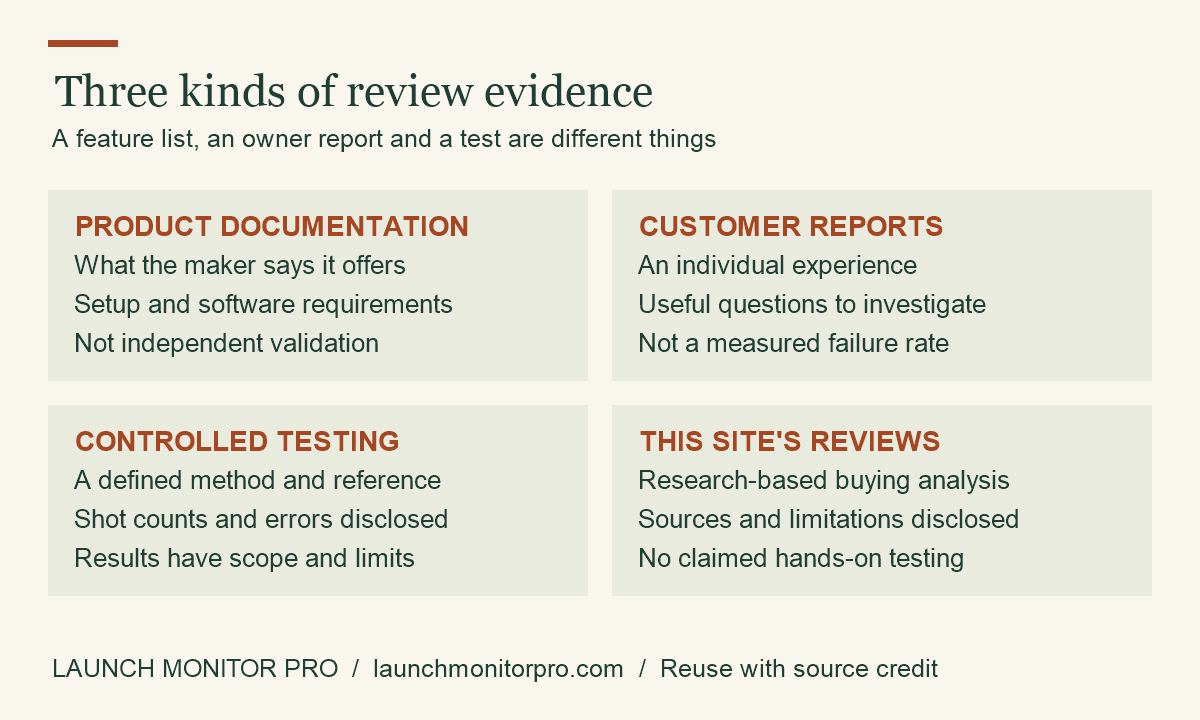
Original explainer by Launch Monitor Pro. You may reuse this graphic with visible credit and a link to the source article. This is a planning aid, not product test data.
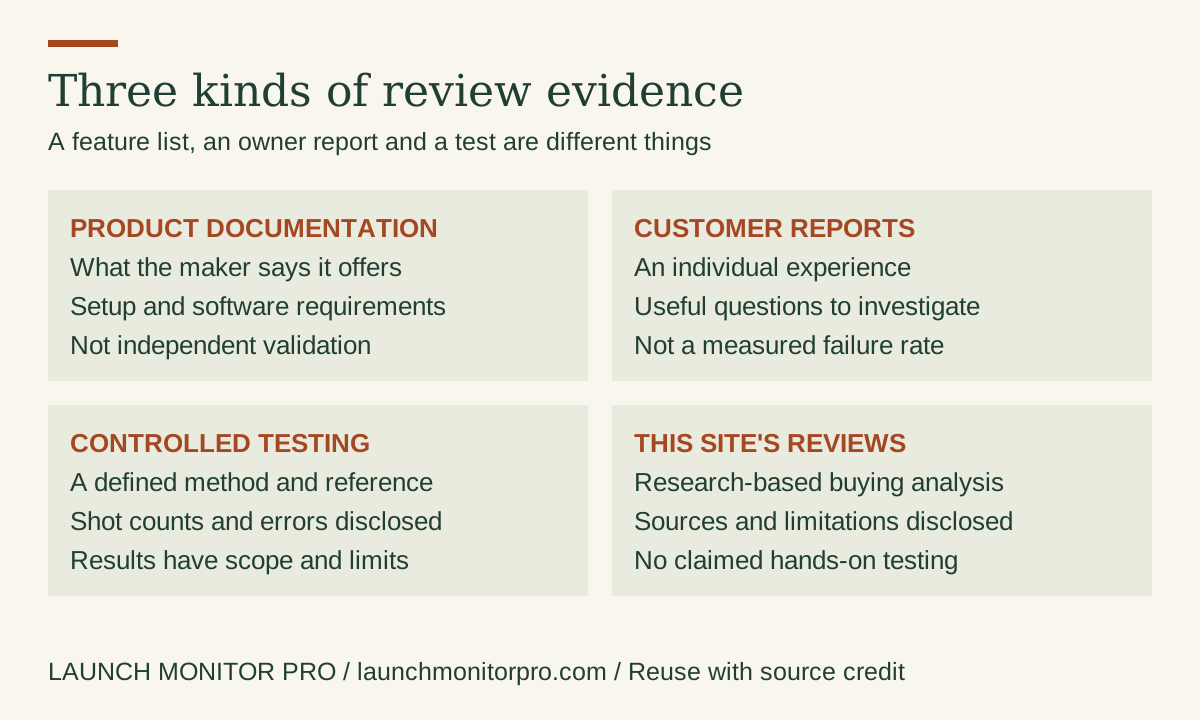
Embed this graphic on your blog
Running costs
Neither device needs a subscription for its core numbers. Shot Scope says the LM1 has no subscription fees and includes free app access. SuperSpeed Golf lists only the device and manual in the HS-130A box.
Who should choose which
- LM1 for golfers who want automatic history, a larger color screen and a weather rating for range use.
- HS-130A for golfers following the SuperSpeed program or who want the smallest possible readout and do not need an app.
- Something else if you need launch angle or spin. The Rapsodo MLM adds launch angle and direction with a phone, and the Garmin R10 adds more data and simulator options.
What we could not verify
We could not find a published battery life or weather rating for the HS-130A on the distributor’s page, and we found no independent test comparing the two units’ carry estimates. We are not including store buttons on this page for now.