
Why the Garmin R10 Struggles with High-Spin Wedge Shots
As we evaluate the current golf landscape in 2026, it remains evident that the Garmin R10 struggles with high-spin wedge shots by occasionally recording data as low as 1000rpm for full wedge swings. This hardware limitation often leaves golfers frustrated when their high-lofted shots appear to fall out of the sky on the simulator screen despite feeling like a pure strike.
Our team has spent extensive time analyzing how this portable Doppler unit compares to more expensive alternatives on the market. We aim to help you understand the physics behind these readings and how to optimize your setup for better accuracy.
Key Takeaways
| Feature/Issue | Explanation |
|---|---|
| Primary Struggle | Difficulty tracking rapid rotation on high-launch shots. |
| Calculated vs. Measured | The R10 often calculates spin based on ball flight rather than measuring the cover directly. |
| Indoor Impact | Limited flight distance indoors reduces the radar’s ability to “see” spin. |
| Best Practice | Use Titleist RCT balls to provide better radar signatures. |
| Our Expertise | Learn more about our dedicated team and our testing process. |
Common Questions from Golfers
Why does my 60-degree wedge show 2000rpm? This is usually due to the radar losing the ball’s rotation signature as it climbs vertically away from the sensor. High-launch angles are historically difficult for entry-level Doppler units to process.
Can firmware updates fix this? While Garmin has improved the algorithms in 2026, the physical limitation of the radar’s field of view remains a factor. You can check our editorial standards for how we verify these technological claims.
Understanding the Wedge Spin Problem
The Garmin R10 uses Doppler radar technology to track the golf ball from the moment of impact until it hits the net or lands. This technology is incredibly effective for tracking ball speed and launch angle, but spin rate is a much more complex metric for a small sensor to capture.
One reason why the Garmin R10 struggles with high-spin wedge shots is the “observation window” available to the device. When you hit a driver, the ball stays in the radar’s direct line of sight for a longer horizontal period compared to a wedge that rockets upward.
With a high-lofted wedge, the ball moves out of the primary radar beam very quickly. This forces the device to rely on its internal algorithms to estimate spin rather than directly measuring it, which often leads to the under-reporting of RPMs.
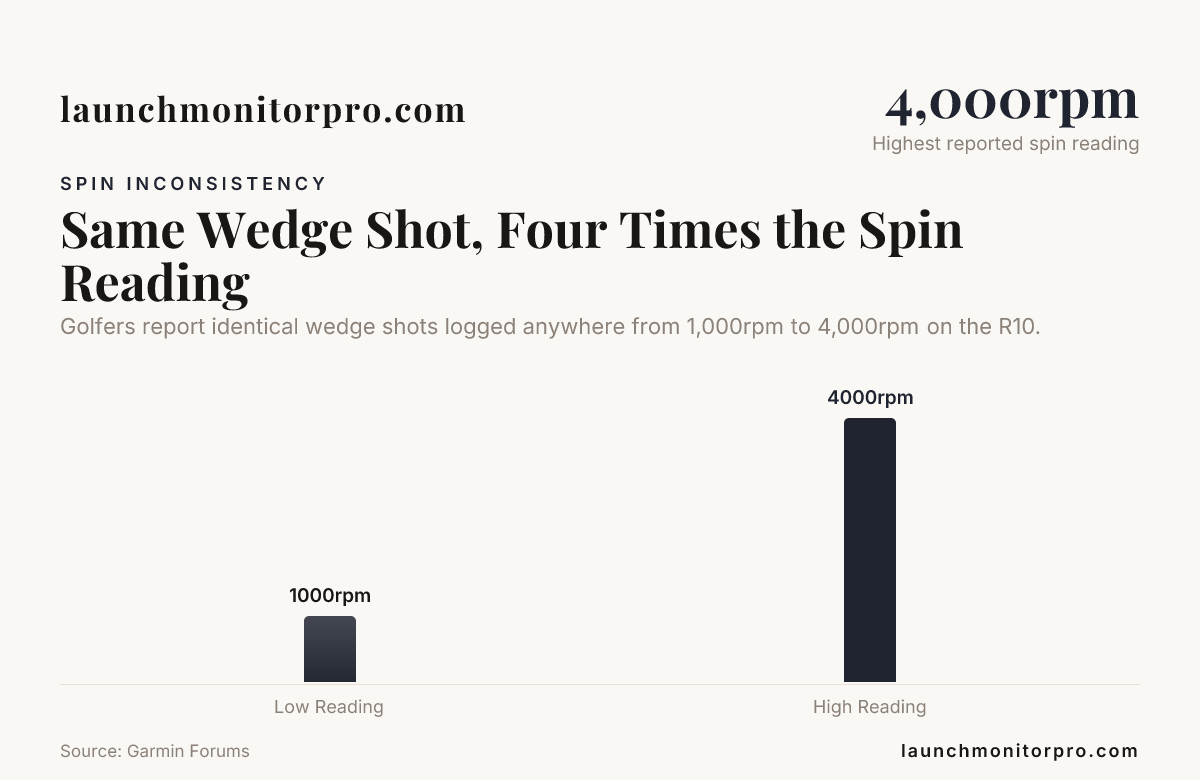
Golfers report identical wedge shots logged anywhere from 1,000rpm to 4,000rpm on the R10.
Comparing Doppler Physics
When we compare the R10 to high-end units like the Trackman, we see a massive difference in the hardware power. The R10 is a consumer-grade device designed for portability, which means it has a smaller sensor array than professional tools.
Professional radar units use multiple frequencies and higher power outputs to maintain a “lock” on the ball’s rotation even at steep launch angles. Because the Garmin R10 struggles with high-spin wedge shots due to its compact design, it cannot always distinguish the subtle surface variations of the ball cover during flight.
In many cases, the unit simply defaults to a “safe” number if it cannot get a clean reading. This is why you might see a series of wedge shots all reading exactly 3500rpm, even if some were hit with significantly more effort than others.
Indoor Limitations
Indoor golf setups present a unique challenge for radar-based launch monitors. In a typical home garage or basement, there are only about 8 to 12 feet of ball flight before the ball hits the impact screen.
This short window is the primary reason why the Garmin R10 struggles with high-spin wedge shots in simulator settings. The radar needs to see the ball rotate several times to calculate an accurate spin rate, and 10 feet of flight is often not enough for a high-loft shot.
Furthermore, indoor environments are often filled with “signal noise” from metal objects, fans, or fluorescent lights. This interference makes it even harder for the R10 to isolate the small, rapid movements of a spinning golf ball.
We recommend reading a detailed Garmin R10 review to see how these indoor environmental factors specifically impact scoring and game improvement. Consistent calibration is key to minimizing these issues.
Software vs. Reality
Garmin uses a complex set of algorithms to “guess” what the spin should be when the radar data is inconclusive. While these algorithms are constantly being improved in 2026, they are not a perfect substitute for measured data.
The fact that the Garmin R10 struggles with high-spin wedge shots is often masked by these calculations in mid-iron shots. However, when the launch angle exceeds 30 degrees, the software has to make bigger assumptions about the ball’s behavior.
If your club path or face angle is slightly different than the average, the software might apply the wrong spin model to your shot. This results in the “knuckleball” effect where a high-spinning wedge shot appears to have no spin on the screen, leading to unrealistic carry distances.
Optimizing the Setup to Improve Wedge Performance
While the hardware has its limits, your physical setup can dictate how much the Garmin R10 struggles with high-spin wedge shots. The distance between the ball and the device is the most critical variable you can control.
Many users place the R10 too close or too far, which confuses the radar’s depth perception. Ensuring the unit is level with the hitting surface is also vital, as any tilt can drastically change the launch angle perception.
We suggest checking out our performance testing data to see how different distances affect the unit’s ability to lock onto the ball. Small adjustments can often lead to more consistent results.
The Impact of Ball Choice on Radar Detection
Another factor in why the Garmin R10 struggles with high-spin wedge shots is the ball itself. Standard range balls or even some premium balls do not have the reflective properties needed for radar to track rotation indoors.
In 2026, Titleist RCT (Radar Capture Technology) balls have become the standard for R10 users. These balls have an internal reflective pattern that helps the radar “see” the rotation much more clearly, especially on short-flight shots.
If you find that your R10 is consistently missing spin data, switching to an RCT ball is the single most effective way to improve accuracy. It bridges the gap between the R10’s affordable sensor and the needs of high-spin short-game practice.
Portability vs. Precision: The 2026 Verdict
Ultimately, we must remember that the R10 is a $600 device competing against units that cost ten times as much. The reason why the Garmin R10 struggles with high-spin wedge shots is largely a trade-off for its incredible price and portability.
For most golfers, having 90% accuracy on full shots and some struggles on wedges is an acceptable compromise. It allows for practice anywhere, from the backyard to the local range, without needing a permanent installation.
If you are a high-level player who relies heavily on precise wedge gapping, you may need to supplement your R10 sessions with time on a photometric launch monitor. However, for the average hobbyist, understanding these quirks allows for a much more productive practice session.
If you have specific questions about your unit, please feel free to reach out to us directly. We are always happy to help our readers troubleshoot their simulator setups.
Conclusion
In conclusion, the reason why the Garmin R10 struggles with high-spin wedge shots is a combination of Doppler radar physics, limited indoor flight windows, and the compact nature of the hardware. While it remains one of the best values in golf technology in 2026, it is not without its specific weaknesses in the short game. By using specialized equipment like Titleist RCT balls and ensuring a precise physical setup, you can significantly mitigate these issues. Understanding that the R10 may under-report spin on your highest wedges will help you better interpret your data and continue improving your game.
Frequently Asked Questions
Is the Garmin R10 worth it for wedge practice in 2026?
The Garmin R10 is still a fantastic value for general practice, though it is not the most precise tool for dedicated wedge gapping. Because the Garmin R10 struggles with high-spin wedge shots, we recommend it primarily for full-swing yardage tracking rather than fine-tuning 20-yard pitches.
Can I fix the low spin readings with a firmware update?
Firmware updates in 2026 have improved the algorithms, but they cannot overcome the physical limits of the radar sensor. If your Garmin R10 struggles with high-spin wedge shots, the best solution is often improving your environment or using specialized radar-reflective golf balls.
How does the Garmin R10 compare to the Bushnell Launch Pro for wedges?
The Bushnell Launch Pro uses cameras (photometric) which are significantly better at capturing spin on short shots compared to the R10’s radar. This is why the Garmin R10 struggles with high-spin wedge shots while camera-based units can measure the spin within a few inches of travel.
Does using a metallic sticker on the ball help the R10?
Metallic stickers can help the radar track rotation, but Titleist RCT balls are a much more reliable solution in 2026. These stickers were a common workaround because the Garmin R10 struggles with high-spin wedge shots when it cannot see a clear rotation pattern on the ball’s surface.
What is the ideal distance for the R10 to capture wedge spin?
We recommend 7 to 8 feet from the device to the ball, and at least 10 to 12 feet of ball flight. Even with this setup, the Garmin R10 struggles with high-spin wedge shots if the launch angle is too steep for the radar beam to follow.
Why are my wedge distances longer on the R10 than on the course?
When the Garmin R10 struggles with high-spin wedge shots, it under-reports spin, which the software interprets as a ball that will “carry” further. Lower spin readings in the simulation lead to less air resistance and more distance than you would see with a high-spinning real-world shot.